Agentic AI Needs Smarter Inference: Hints, Priority, and Cache Lifecycle

Agentic AI is very good at making infrastructure assumptions look adorable.
The old assumption was simple: a user sends a request, the model returns an answer, the service logs a latency number, and everyone pretends the world is shaped like a single HTTP call.
Agents do not behave like that.
An agent plans, calls tools, waits on APIs, reads files, retrieves context, validates outputs, starts sub-tasks, changes its mind, and asks the model again. A single user-visible task may contain many model calls separated by non-model work. Some calls are urgent because a person is waiting. Some are background research. Some reuse long-lived context. Some create scratch state that should be evicted as soon as the agent walks away from it.
If the inference runtime treats all of those requests the same, it is flying blind while the agent harness is sitting nearby with a flashlight.
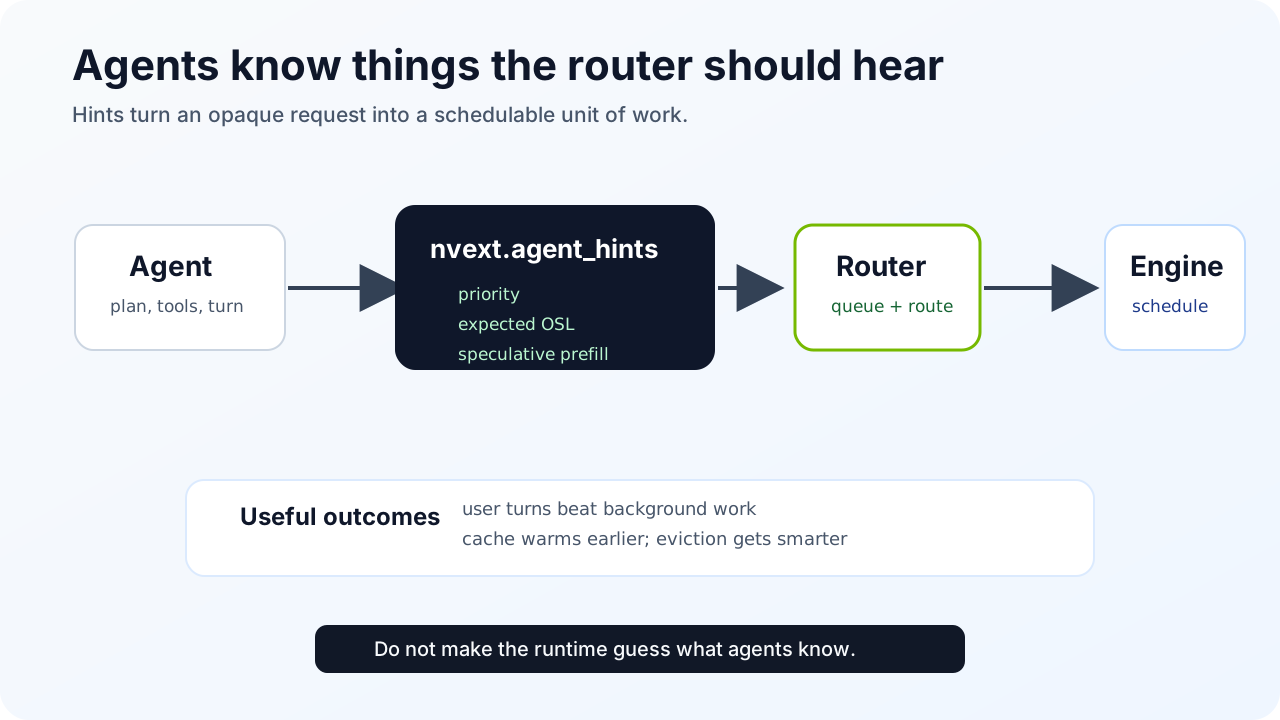
Dynamo’s agentic hints are interesting because they give the runtime a way to hear what the agent already knows.
Agents create structured chaos
Agent workloads look chaotic from the outside, but they often have structure.
A code agent may alternate between planning, file search, model calls, shell commands, test output, and edits. A research agent may fan out to retrieval tasks, summarize intermediate findings, and then synthesize. A support agent may reuse the same policy pack and tool schemas all day. A security agent may run lower-priority background analysis while user-facing turns need fast feedback.
The runtime sees requests.
The harness sees a workflow.
That mismatch is expensive.
Without workload hints, a router may not know:
- this turn is user-facing and should beat background work
- this request is likely to produce a short answer
- this agent will probably ask a follow-up turn with a predictable prefix
- this context is a long-lived system prompt worth keeping warm
- this scratch branch is low-value after the tool result arrives
- this sub-task should stay isolated from another sub-task’s KV state
The model does not need to know all of that. The serving runtime does.
The three hint types that matter first
Dynamo’s Agents guide documents nvext.agent_hints inside the request body. The frontend parses the hints and passes them to routing and backend layers where applicable.
The currently documented hints include:
| Hint | What it means | Why operators should care |
|---|---|---|
priority | A unified request priority | Helps route and schedule user-facing turns ahead of bulk work under load |
osl | Expected output sequence length | Improves output block tracking and load-balancing accuracy when enabled |
speculative_prefill | Whether to warm the predicted next-turn prefix | Can reduce later-turn first-token latency when the next prefix is predictable |
The docs also mark program_id and context_type as planned fields. That distinction matters. They are good ideas, but they should not be described as broadly available production features until support lands.
This is the kind of factual caution that makes infrastructure writing less spicy but more useful.
Priority is not cheating
Priority scheduling can sound unfair if you think all work is equal.
Agent work is not equal.
A user-facing model call in an interactive session is not the same as a background summarization task. A high-value tool validation step may be more important than a speculative branch. A request holding a human in the UI should often beat a batch job whose result can arrive later.
Dynamo’s routing docs describe queue thresholds and queue policies, and the Agents guide says higher priority values can move a request earlier in the router queue and be forwarded to backend scheduling where supported. Under load, priority-aware routing can preserve interactive latency while background tasks accept more waiting.
That is not cheating. That is product-aware scheduling.
The important guardrail is transparency. Priority should be observable. Operators should know which workloads are allowed to set it, what values mean, and whether a tenant can starve another tenant by yelling “urgent” into every request.
Every priority system eventually needs adult supervision.
Expected output length is boring and excellent
The osl hint is not glamorous. It is also exactly the kind of signal a runtime needs.
If the harness expects a short classification-style response, that request should not be treated like a long reasoning answer. If an agent is about to produce a large final synthesis, the router should not pretend it will occupy decode capacity for the same amount of time as a one-sentence tool decision.
Expected output length helps load balancing because decode work is not free. Output tokens consume scheduling time, KV cache, and stream lifetime. The router cannot know the future perfectly, but the harness often has a better guess than the runtime.
Even an imperfect hint can improve planning if it is calibrated and monitored.
This is a theme with agentic inference: useful metadata beats runtime clairvoyance.
Speculative prefill is the neat trick
Speculative prefill takes advantage of the fact that agents often know what the next prefix will look like.
After a turn finishes, the system may be able to prefill the predicted next-turn prefix, such as conversation history plus assistant text, so that the next real request hits warm KV cache. The Dynamo Agents guide describes this as sending a speculative max_tokens=1 prefill after a turn completes, then reusing the warm cache when the next request arrives.
This can help multi-turn agent flows where the next prefix is predictable and reuse is likely.
It is not magic.
Speculative prefill can waste work if the next turn never arrives, if the prediction is wrong, or if the cache pressure evicts more valuable blocks. It needs policy: when to do it, which workloads qualify, how much budget it can spend, and how to measure whether it helped.
The attractive part is that it turns idle gaps into preparation. While the agent waits on a tool or the user reads streamed output, the serving system can warm the path for the next turn.
That is very agentic. Use the pauses.
Cache lifecycle is the next frontier
Traditional cache eviction often starts with recency. Least recently used is a good default in many systems. Agentic inference needs more nuance.
The Agents guide calls out a key problem: generic eviction does not distinguish high-value, long-lived context from ephemeral context. A system prompt and tool definitions may be reused across many turns. A failed reasoning branch or scratchpad may be nearly worthless once the branch closes.
That is why cache lifecycle matters.
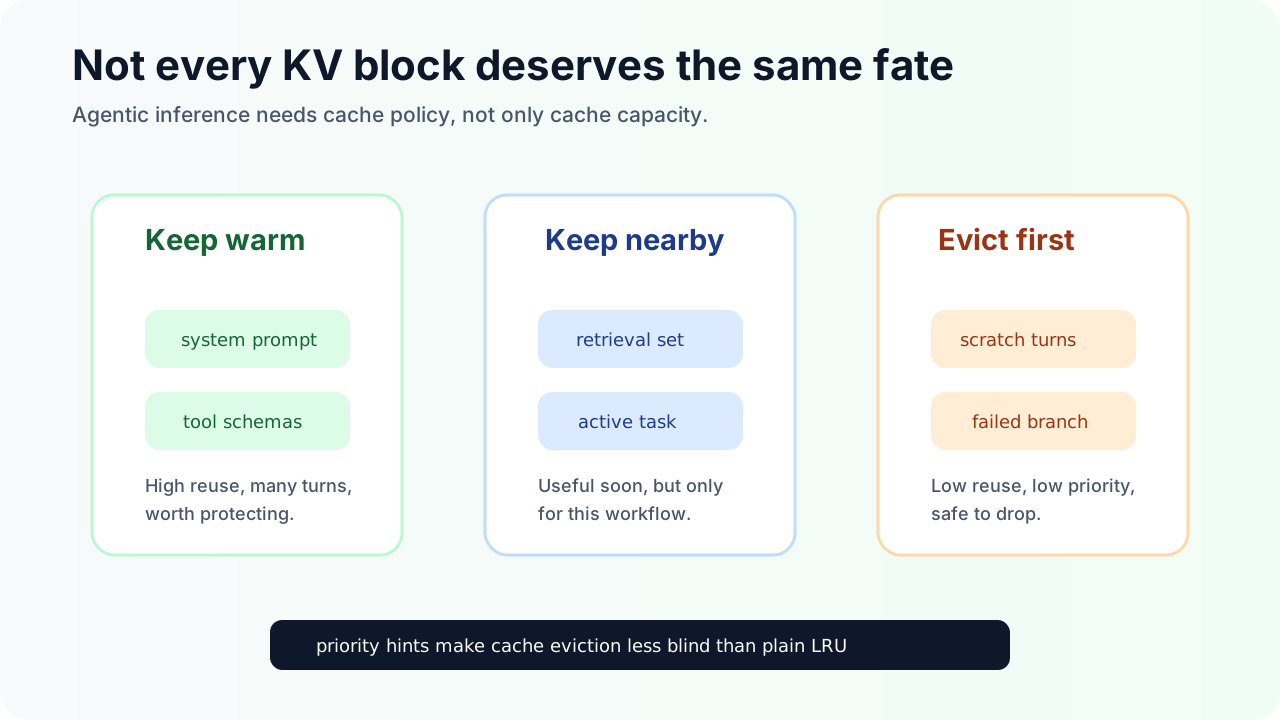
A practical cache policy might think in three buckets:
| Cache class | Examples | Desired behavior |
|---|---|---|
| Keep warm | system prompts, tool schemas, policy packs | Protect when reuse is high and tenant boundaries allow it |
| Keep nearby | active task context, current retrieval set | Favor while the workflow is active |
| Evict first | failed branches, scratch turns, one-off pasted logs | Drop under pressure before durable context |
Dynamo’s current documented support includes priority-based cache eviction in specific backend contexts. The docs mention that the priority value can be forwarded to the engine, and with SGLang there are flags for priority scheduling and priority radix eviction policy. The same guide marks some other agentic cache features as experimental, future work, or planned.
That nuance matters. The direction is important, but production teams should map features to the backend they actually run.
The runtime should not guess the workflow
One of the more useful ideas in the Dynamo Agents guide is the distinction between reactive and proactive inference.
A workload-agnostic runtime waits for requests, then reacts. An agent-aware runtime can use harness signals about what is likely to happen next. If a plan step is done and execution steps are coming, the runtime can make better routing and cache decisions. If a request is background work, it can wait. If the next turn prefix is predictable, it can be warmed.
This is a clean interface boundary.
The harness should not micromanage GPU kernels. The runtime should not invent workflow semantics from log lines. Hints are the middle ground: small pieces of metadata that let the runtime schedule smarter without becoming the agent framework.
That is the right separation of concerns.
Security and fairness cannot be afterthoughts
Agent hints are powerful enough to deserve guardrails.
If clients can set priority, someone will eventually set every request to maximum priority and claim it was an accident. If cache affinity crosses tenant boundaries, someone has built a compliance incident. If speculative prefill is unbounded, background warming can burn capacity needed by real users. If expected output length is consistently wrong, the router can make bad load decisions with confidence, which is the most dangerous kind of bad decision.
The platform should enforce:
- allowed priority ranges per tenant or workload
- audit logs for priority use
- tenant-aware cache keys
- speculative prefill budgets
- fallback routing when hints are missing or suspicious
- metrics comparing hinted OSL to actual output length
- clear feature gates by backend
Hints should make the runtime smarter. They should not let clients bully it.
What I would instrument
For an agentic inference deployment, I would want dashboards that answer these questions:
- How much traffic carries
nvext.agent_hints? - Which workloads set priority, and what values do they use?
- Did priority reduce user-facing latency under load?
- How accurate is expected OSL compared with actual output length?
- How often does speculative prefill lead to a real cache hit?
- How much capacity is spent on speculative work that is never reused?
- Which cache entries are evicted under pressure?
- Are high-priority cache entries actually surviving longer?
- Do fallback routes increase when cache event confidence drops?
- Are backend-specific features enabled consistently with the feature matrix?
If you cannot measure whether hints help, they become a belief system. Infrastructure already has enough belief systems.
Why this is bigger than Dynamo
Dynamo is one implementation path, but the architectural idea is broader.
Agentic AI needs inference runtimes that understand workflow signals. That does not mean every runtime becomes an agent framework. It means the serving layer accepts that requests are part of longer-lived programs with priorities, context lifecycles, and predictable phases.
The next generation of inference platforms will likely compete on this kind of system behavior:
- routing that understands KV cache and prompt cost
- scheduling that understands user-facing versus background work
- memory management that understands context value
- autoscaling that understands TTFT and per-token latency
- observability that follows a task across many model calls
- security that treats tools, prompts, and cache boundaries as first-class
The GPU still creates the tokens. The runtime decides whether those tokens arrive at the right time, for the right workload, at the right cost.
That is why hints matter.
They are small fields in a request body, but they represent a larger shift: inference is becoming workload-aware.
The practical takeaway
Agentic inference is not just more model calls.
It is more structure around model calls.
The agent knows when a turn is urgent, when output is likely short, when a next prefix is predictable, and which context is worth preserving. A smart runtime should use those signals. Dynamo’s nvext.agent_hints, priority-aware routing, speculative prefill, and cache-lifecycle direction are early examples of this pattern.
The future serving stack will not treat every request like a stateless blob.
It will ask better questions:
- Is this user-facing?
- How long will it likely decode?
- What cache state is valuable?
- What can be warmed before the next turn?
- What can be evicted without regret?
That is how agentic AI becomes less mysterious in production.
Not by making the model smarter.
By making the serving system stop pretending it knows nothing.
Sources and receipts
- Dynamo agent hints, priority, speculative prefill, and feature status: Agents.
- Dynamo router queue and routing options: KV Cache Aware Routing.
- KVBM memory and cache lifecycle foundations: KVBM.
- Backend support caveats: Feature Matrix.